September 24, 2012

In case you couldn’t make it


THIN AIR 2012 - Forewords: Saturday, September 22, Free Press News Café
by Jeannette Bodnar

I arrived at the Free Press News Café just in time for my husband and I to grab the second last table. Although the building was packed, it felt comfortable. Like a family dinner but without the resentment and the cousin that’s not allowed to play with matches. Even though it’s autumn, the energy in the building felt like spring, like youth, like beginnings; the perfect opening weekend energy. 
Charlene Diehl and Bruce Symaka took the stage and wasted no time getting the night started. First on the ticket, slam poetry. 
Now I wasn’t sure what to expect. I’ve seen spoken word, but never live, and never from Winnipeg artists (not for lack of want). In fact, for the past few years my husband and I have spent many a Friday night sharing $10 bottles of wine and YouTubing old DefJam footage. More ritual than “social life” per se, but you’ll take what you can get when you have two kids and mounting student debt. Still, I’m uncertain how Manitoba’s finest can compare.
Judging by the audience reaction, I was not the only one blown away. I can’t summarize how amazing this group is. In fact, I feel like a jackass using the word amazing because I know if they were writing this blog they would never use a conventional word like amazing. Not because they would feel it was beneath them, just because it is. 
After they finished, Corey Redekop compared them to the Rolling Stones and I laughed because two people allegedly snuck into the sold out venue. I now suspect they were groupies, although, no lingerie was thrown on stage so maybe not.
After a brief intermission, Corey read from his book Husk. As you would expect from a Zombie novel the passages were quite grotesque and insanely funny. Just ask the woman behind me who, judging by the intensity of her laughter, I’m pretty sure peed just a little bit in her pants. I’m not sure how long Corey was on stage I just know it should have been longer.
During the final intermission he signed my copy of Husk and I signed his. I realized that I should probably never be published for the simple fact that I inevitably sign everything the same way I signed my grade eight year book. “Never change Corey—your BFF”.
After a final intermission Corey and three of Winnipeg’s finest poets took to the stage for a Haiku Death Match. I didn’t think things could get funnier than a reading about a Zombie who eats his boyfriend. In retrospect, I hope the woman behind me took advantage of the intermission for a bathroom break. I’m not exaggerating when I say that people were laughing so hard that there were tears and snorts. A particular highlight was after Aaron Simm’s poem about peeling potatoes without pants on. During which time the most perfect pause in the laughter and chatter happened, so that audience was treated to woman admitting that she just pictured Aaron naked. You know who are lady, and so do we (wink). I loved this part of the night so much that I’ve decided I’m going to push for Thin Air haiku fortune cookies for next year’s festival.
Anyway that was my night. It was an amazing opening weekend and I can’t wait for the week ahead. 
Never change people—your BFF.    


September 20, 2012

Looking Back: THIN AIR 2011


By Nan Forler

This time of year, as nights become cooler and pumpkin lattes start brewing in neighbourhood coffee shops, I find myself being drawn to local bookstores, eagerly anticipating the new fall releases. But this year, I am feeling a bit homesick for my new favourite autumn reading event: The Winnipeg THIN AIR Festival.  

Last September, I was very fortunate to have been invited to THIN AIR as a featured author in the Writers to the Schools program. I had taken part in writer’s festivals before, but this was the first time I was actually flown in, complete with a hotel room and hospitality suite. I am certain all future events will pale in comparison!

THIN AIR is led by Charlene Diehl, a fiercely passionate advocate of Canadian books, described by one of the authors as the kind of person who makes a party come alive. She very intentionally sets a social tone, encouraging interaction between writers and readers, and creating a celebration of books with lively discussion. 

Immediately upon meeting Charlene, she encouraged me to hop in the back of her car with Elizabeth Hay for an afternoon book chat at McNally Robinson. The evening readings carried on this atmosphere. They were held on a party-esque stage set, where audience members were invited onto the stage during intermission to mingle with the authors, or enjoy a drink on the comfy couch.

For me, the highlight of the week was my road trip to Winkler, Manitoba. Charlene and her fabulous team arranged school visits to this area, matching my new book, Winterberries and Apple Blossoms: Reflections and Flavors of a Mennonite Life, with the children of rural Manitoba, many of whom had a Mennonite background.  

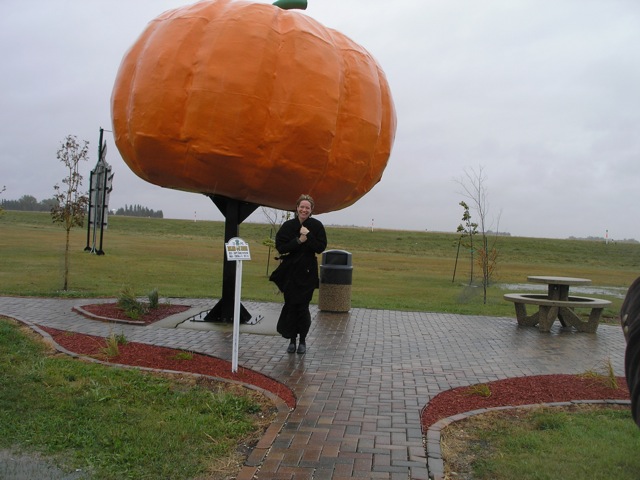
I travelled with a fun and adventurous entourage, including Eva, a festival volunteer, her sister, Tina, and Charlene’s mom, Anna Grace. We braved relentless rain and 100 km/hour winds as we travelled from school to school, stopping in Roland, Manitoba, to have a blustery photo taken in front of “The World’s Largest Pumpkin.”

In the midst of this season of book releases and reviews, it was the children in the schools I visited who provided the true reminder that books are a living, breathing entity that come to life in their active imaginations.  

When sharing the message of the bystander in Bird Child, the children were anxious to relate their personal experiences to me about responding to bullying situations in the schoolyard. As I introduced Winterberries and Apple Blossoms, I was able to witness their animated reactions, as they recognized their own lives in the paintings and poems depicting coming-of-age in a Mennonite community.

From the rural kids in Winkler, many of whom were Mexican Mennonites, who filed in silently, then sat, arms crossed, listening attentively, hanging on every word, to the multicultural classes in Winnipeg the following day, who bounded in, uninhibited and curious, their arms around me afterwards to be first to ask a question, I was witness to the incredible joy children experience in being read to.

Sitting in the darkened theatre for the THIN AIR events that evening, being read to by the likes of Guy Vanderhaeghe and Lynn Coady, I was struck once again by the human connection that comes from this solitary act of writing.  
I felt so honoured to have been a part of this book-affirming week in Winnipeg and I wish all the best to you lucky souls who will be enjoying THIN AIR this month.

Happy Reading!
Nan


September 16, 2012

Film and Poetry: Hitchcock, Lynch, Tarkovsky, and the Politics of Knives


by Jonathan Ball

My recent book, The Politics of Knives features nine long poems with interlinking elements. One common thread is the influence of film on my poetry, specifically the work of three filmmakers: Hitchcock, Lynch, and Tarkovsky.

Hitchcock’s film Psycho is the most obvious of these influences, given that one of the book’s nine poems is called “Psycho” and describes the film poetically, with a perverse focus on the story’s protagonist, Marion Crane. Unconventionally, Crane is murdered partway through Hitchcock’s film, which then has to seek a new protagonist (after her death, the camera seems lost, but it soon settles on Bates, the “psycho” of the title). 

Many of Hitchcock’s films attempt to trouble the act of the audience watching the film, by turning audience interest into the subject of the film itself. We watch Crane just as Norman watches her, through a hole in the wall that simulates the eye of the camera (in a shot where, unsettlingly, we share the killer’s point of view). Most strikingly, after she’s stabbed, Marion reaches up for help — reaching out towards us, as if she knows we’re watching. And enjoying the movie. We don’t help her.

Lynch’s mastery comes from dramatic shifts in tone, his ability to move in an instant from a banal to a nightmarish realm. He continually sacrifices sense for tone, and in the course of this shift he creates strange, poetic worlds that we move through emotionally but which make little logical sense, although there is a poetic logic that underlies and gives order to Lynch’s worlds. 

I try to use language in a similar manner throughout the book, which has a sort of grammatical slipperiness. A sentence will begin as if describing a scene (“The mist dissolved…”) but then switch the grammar to describe an event (“The mist dissolved what it did not need”) with an alien actor (here, the mist becomes a sort of living force). 

Tarkovsky’s poetic approach to filmmaking, and his occasional use of genre material (horror and science fiction plots) have inspired me, but especially influential are his occasional, striking long takes.  The book’s final poem, 
“That Most Terrible of Dogs,” is structured like a long film take — like a slow movement across a cultural wasteland, toward some inevitable terror.  

Jonathan Ball joins Lorna Crozier, Sue Goyette, Patrick Lane, and JonArno Lawson for THIN AIR 2012's Poetry Bash, Friday, September 28th, 8:00pm on the Mainstage, MTYP at the Forks. Tickets are $12/$10 students and seniors.

Ball also helps kicks off the festival on opening night as an advocate for Manitoba Reads. He's be promoting Automatic World by Stuan Sinclair in a celebration of the province's rich writing culture. Friday, September 21st, 8:00pm at CCFM/Centre culturel franco-manitobain. Tickets $5.
Visit him online at www.jonathanball.com or @jonathanballcom.


David Bergen: A Fan's Appreciation


by Tannis Sprott

I haven't lived in Manitoba for 29 years, and my feelings about my childhood, and memories of living there, tend to be greatly influenced by what's going on in my life at any given moment. When I'm stuck on the 401 heading into Toronto in rush hour, I desperately miss being able to walk from one side of town to the other in 15 minutes (20 if you dawdled, and really, why wouldn't you?). Then there are the times when I want to try cooking something exotic for dinner , much easier to do in the city.

In general, my memories are centred around nostalgic visions of glorious sunsets, starry skies on crystal clear nights, the sound of snow crunching under foot instead of shplopping, the (incessant) wind in my hair, etc., etc. 

Imagine my surprise, then, when I had what can only be described as a visceral experience when reading David Bergen's "The Age of Hope", a story which follows the life of Hope, who grows up in Eden, Manitoba, gives up nursing school to marry Roy Koop, bears four children, and spends a lifetime struggling with who she is, where she is, and how she seems to dance on the periphery of the life she imagines she wants.

Bergen so profoundly caught the essence of small town life - Hope's sense of being constrained by the smallness of her world; her desire to broaden her experiences, but never quite sure how to go about it; her sense of isolation that continues, even though her life is actually a tremendously full one. I learned to love her through the course of the book, living her life right along side her for five decades.

And I have David Bergen to thank for cleaning the dust off my rear view mirror, allowing a whole cascade of memories to come flooding back. It's interesting how belonging to a small community, where everyone knows everyone else, can be both incredibly supportive, and tremendously isolating. I'm looking forward to Tuesday night with great anticipation, as literary stars David Bergen (with "The Age of Hope") and Richard Ford (with "Canada") compare fictional notes on all things prairie. With any luck, it will be a clear Manitoba night, and I can get reacquainted with those other stars after the show. What a wondrous homecoming that would be!

Tannis Sprott currently lives in Guelph, Ontario but will soon be "home" temporarily.
Look for more posts by Tannis throughout THIN AIR 2012.

In defense of the short story

By Carrie Snyder


I’ve been thinking quite a lot about the short story form. The jacket copy on my book, The Juliet Stories, categorizes it as a “novel-in-stories.” That seems as accurate to me; but the funny thing is that not everyone agrees. 

Photo by Nancy Forde
“These are not stories, this is a novel,” I’ve been told by more than one reader.

Fair enough. Reading is an individual experience. And I suppose I could see it as a bit of a compliment: everyone wants to write a novel, right? Maybe I’m just being touchy on the subject.

Truth is, when I started writing The Juliet Stories, it was a novel. And it didn’t work. I wrote and re-wrote the damn thing, but nothing about it wanted to be a novel. Eventually I gave up, but the material wouldn’t quit my consciousness, so I wrote a story. And another. And a few more, until—to skip over a whole lot of angst and gritty, dull work—I had a book. A “novel-in-stories.”

Is this a confession of failure? That the material I tried to shape into a novel refused my entreaties to fit to form? I’m not sure. It could be that I’m not a novelist. Or it could be that a tale knows how it wants to be told. 

A short story is, by definition, shorter than a novel. It might be longer than a poem, but then again, it might not be. A short story is, often, just about exactly the length of a chapter. 

So why not call them chapters, when strung together to make a coherent whole?

Each chapter in The Juliet Stories was written as a short story; if removed from context, it’s meant to stand on its own. I never thought of any as being a chapter leading to another chapter. That said, these stories belong together. They serve a larger whole. They are placed chronologically, and the characters remain themselves throughout the book, changing as characters do, and don’t, according to their development. The book has an overarching plot, unifying themes. 

I know all of that. But I think these remain stories, at heart.

Each curves back on itself at the end, so you see its beginning in a new way. Much happens, but plot is not the focal point. Mood is, and sensation, and attention to detail. There is something fragile about stories, something open-ended, something that points to mystery.

It isn’t that I don’t want you to read The Juliet Stories as a novel. Of course you may. But don’t make it be a novel. Don’t make it end, like novels end, at The End. Let it be, maybe, a meditation on the things we can’t say, we only understand, or believe, or feel; or, let it be like a memory, something you’ll think about and wonder about, but never pin down in absolute terms.

Because I’m pretty sure that’s what a short story is. And that’s why I write them. 


Carrie Snyder joins Meira Cook, Stella Leventoyannis Harvey, Cordelia Strube, Richard Van Camp, and Jess Walter on Mainstage, "Life Lessons" on Monday, September 24th, 8pm, at MTYP The Forks.

The next day, Tuesday, September, 25th, she joins Cordeila Strube for Afternoon Book Chat, with Festival Director Charlene Director, at McNally Robinson, 2:30-3:30pm.


Visit Carrie Snyder at carrieannesnyder.blogspot.com/

Thin Air in Two Cities


Méira Cook on the inspiration for her new novel...
and why THIN AIR always surprises her


I was born in Johannesburg, South Africa, where I lived for twenty-five years before immigrating to Canada. When I was growing up in the seventies it was customary for white middle class families to employ a nanny to look after their children. The nanny was, of course, black although she could have been of Zulu or Xhosa or Sotho or Tswana descent but these important distinctions were not considered by the affluent and largely oblivious white society of the time. Since the nanny had to live with the white family — invariably in the servant’s quarters behind the kitchen — she was separated from her own family because in those days of Apartheid black folks couldn’t live in “white neighbourhoods.” Her own children were sent to live with relatives in the townships if they were lucky, in the homelands if they were not.
I’ve always found the relationship between what South Africans once called “maids and madams” to be a source of great curiosity, vast exasperation, some shame, and in the end — because all that turmoil of emotion has to find its outlet — creativity. My novel, The House on Sugarbush Road, tells the story of two families, two “houses.” Beauty Mapule has worked for a prominent Afrikaner family for more than thirty years, her reign has spanned successive du Plessis generations. What I loved exploring was the idea that the relationship between domestic servant and employer is not necessarily submissive, or even particularly domesticated. There is enormous potential for subversion and unruliness, for surprise and even for tenderness between people who are not family, not friends, not compatriots, and yet who’ve lived together for many years.
That’s sort of how I feel about reading at Thin Air too. I mean the part about unruliness and surprise. Charlene and her crew run a splendid event but the part I love best is the element of quirkiness and, yes, subversion that always creeps into the proceedings. Think, for example, of the festival’s name which is a masterful stroke of creative misdirection. Thin Air always seems to me to evoke a rarified atmosphere of highbrow, pointy-headed Bookistes who ply their craft in a menacing, slightly precarious city largely populated by consumptives. Au very contraire!
The Winnipeg Writers’ Festival is famous for its rollicking good humour, its throngs of word-greedy readers, its crowds of page-turning omnivores hungry for the gloriously eclectic selections that are offered up. You have to love the eccentricity of it, the exuberance and joy, and the way a kind of prestidigitation seems to be at work. A wave of the hand and it could all vanish into . . . 

Méira Cook joins Stella Leventoyannis Harvey and Festival Director Charlene Diehl for Afternoon Book Chat, Monday, September 24th, 2:30-3:30pm at McNally Robinson. Admission is free.
That evening, at 8:00pm, Cook and Leventoyannis Harvey, along with Carrie Snyder, Cordelia Strube, Richard Van Camp, and Jess Walter, feature on the Mainstage for "Life Lessons" at MTYP at the Forks. $12/$10 students and seniors.


September 13, 2012

JonArno Lawson on Coming Back to Winnipeg

When I came to read at Thin Air in Winnipeg the first time, in 2008, it was already a city where I felt at home. My brother had lived in Winnipeg for ten years as part of the Primus theatre company, and I'd made several trips out during the 1990s to see his shows. Back then, it had never occurred to me that I might be on a stage in Winnipeg myself someday. . . 

The warm, down-to-earth reception of my work (and of myself!) are dearly treasured memories. I still use my souvenir Thin Air coffee cup for my morning tea because it's a reminder of the happy days I spent at the festival, and it reminds me that there might actually be people out there who are interested in what I'm doing.

I'd always hoped to be invited back (what a complicated task for Charlene! Canada is overflowing with talented, prolific writers, and everyone deserves a hearing, don't you think?), but never expected it - so when the summons came I was overjoyed.

I'm very much looking forward to meeting the students at Oak Bluff Community School, and at the Collegiate of the University of Winnipeg. Also to sharing the stage with Jonathan Ball, Lorna Crozier, Sue Goyette, and Patrick Lane - what a line-up - I hope I'm not last up. . .!


JonArno Lawson joins Jonathan Ball, Lorna Crozier, Sue Goyette, and Patrick Lane for  the Poetry Bash on the Mainstage at MTYP, The Forks, on Friday, September 28th at 8:00pm. He'll also be put and about as part of the THIN AIR 2012 School Program.